
AI-agent risk is becoming insurable—and potentially excluded.
01 September 2026
As organisations give AI agents greater authority to access systems, make decisions and execute actions, a new risk question is emerging:
What happens when an authorised AI agent causes an unintended loss?
Some insurers like MSIG, QBE and Beazley are reviewing their cyber-policy wording as autonomous agents blur traditional definitions of:
- An attacker
- Authorised access
- Human responsibility
- System failure
- Liability for autonomous decisions
The problem is that an organisation may deliberately give an AI agent valid credentials and permission to act. If that agent then exposes data, disrupts operations or makes a costly decision, the loss may fall between cyber insurance, professional indemnity and technology-performance cover. Some insurers are already considering exclusions for systemic AI events or losses caused by agents operating as designed.
This expands the meaning of Responsible AI. It can no longer focus only on regulatory compliance, ethics and model accuracy. It must also address insurability and the contractual allocation of AI failure.
Before an AI agent moves into production, organisations should be able to answer:
- What systems and data can it access?
- What actions can it take independently?
- How is it contained when something goes wrong?
- When must a human intervene?
- What performance thresholds apply?
- Who carries the financial loss if it fails?
AI pilots prove that the technology works. Production deployments must prove that the risk is understood, controlled and allocated.
Source: Reuters, 27–28 August 2026
A Bank Account Is Not Financial Inclusion
26 August 2026
The next challenge for banks is not simply expanding access. It is making financial services more relevant, responsible and resilient for the people who need them most. For much of the past two decades, financial inclusion has focused on access.
Can people open a bank account? Can they make digital payments? Can they receive money electronically? Can they access credit?
These remain important questions. But they are no longer enough.
A customer can have a bank account and still rely on an informal lender when a child needs to go to school. A farmer can have a mobile wallet and still have no suitable way to finance the next planting season. A small business can accept digital payments and still collapse when a major customer pays an invoice 60 days late. Access to financial services does not necessarily mean access to relevant financial services.
The Bangko Sentral ng Pilipinas (BSP) makes this distinction explicitly. Its National Strategy for Financial Inclusion defines effective access as more than the availability of financial products: those products must be appropriately designed, good quality and responsive to people’s needs. The ultimate objective is not access itself but improved financial health and resilience.
The BSP’s 2025 Consumer Finance and Inclusion Survey reinforces the challenge. While progress has been made in financial confidence and the ability to meet everyday expenses, financial resilience remains comparatively weak, particularly among lower-income and less-educated Filipinos.
This raises a more important question.
What role can banks really play?
There are five areas where banks — particularly those serving lower-income, rural and small-business communities — can make a meaningful difference.
1. Turn access into relevance
Underserved customers do not necessarily need more financial products. They need the right product at the right moment.
- A farmer may need financing aligned to a harvest cycle rather than a conventional monthly repayment loan.
- A family may need a small school-fee facility timed to the academic calendar.
- A microenterprise may need working capital based on the timing of actual customer receipts.
- A household with irregular income may need a savings product that accommodates irregular contributions rather than assuming a monthly salary.
- And a customer vulnerable to climate, health or livelihood shocks may benefit more from an affordable insurance product than another loan.
This changes the role of technology. AI should not simply be used to determine which product a bank can sell next. It can help banks identify patterns of need, understand financial behaviour and match customers with services that better reflect their circumstances. The proposition becomes:
We understand your financial rhythm, and we can offer something that fits.That is very different from pushing standardised products to increasingly digital channels.
2. Make credit more responsible — not merely faster
Much of the discussion around digital lending celebrates speed. Applications that once took days can now be processed in minutes. Automated decisioning can lower costs and extend credit to customers who were previously expensive to assess. These are important advances.
But faster credit is not necessarily better credit. For lower-income households and microenterprises, affordability is often not simply a function of annual income. It is a function of timing.
- When does income arrive?
- When do expenses spike?
- How predictable is cash flow?
- Is a customer experiencing temporary pressure or a structural inability to repay?
Technology gives banks the opportunity to understand this far better. Alternative data, transaction patterns and cash-flow analysis can help lenders assess customers who may lack traditional collateral or formal credit histories. AI can potentially identify emerging financial distress earlier and allow a bank to intervene before missed payments become default. That intervention does not always need to mean more lending. It might mean:
- a smaller facility
- a different repayment schedule
- temporary payment flexibility
- restructuring
- a savings intervention
- or, in some cases, declining credit that the customer cannot reasonably afford.
That is a very different objective from maximising loan approvals. The goal should not be more credit. It should be better-fit credit.
3. Help customers become more resilient to shocks
For many lower-income households and small businesses, financial vulnerability is driven by shocks.
- A medical emergency.
- Crop failure.
- Flood or typhoon.
- Death in the family.
- Vehicle breakdown.
- Loss of employment.
- A customer paying an invoice late.
- A school-fee deadline arriving before income does.
Any one of these can push a financially vulnerable household or microenterprise towards expensive debt. This is why resilience is becoming increasingly important in the financial-inclusion debate. CGAP argues that inclusive finance can help lower-income people and micro and small enterprises anticipate, cope with and recover from increasingly interconnected economic, climate and livelihood shocks.
Banks therefore have an opportunity to think beyond individual products and help customers build a financial resilience stack.
That could include a combination of:
- emergency savings;
- affordable insurance;
- responsible short-term credit;
- payment flexibility;
- early-warning alerts;
- restructuring pathways;
- remittance-linked savings;
- crop or climate-risk products;
- and business-continuity financing for microenterprises.
The purpose is not to eliminate financial shocks. Banks cannot do that.
It is to help customers absorb those shocks without being pushed into destructive debt or financial collapse. That is a far more meaningful interpretation of financial inclusion.
4. Turn financial education into timely financial assistance
Financial literacy has long been seen as an important component of financial inclusion. But there is a limitation to traditional financial education. Knowing that saving is important does not necessarily help someone decide what to do when income is irregular, a loan repayment is due next week and school fees are payable at the end of the month. This is another area where intelligent technology could change the economics of serving lower-income customers.
Instead of generic financial education, banks could increasingly provide simple, contextual and timely assistance. For example:
Your normal electricity payment is due next week and your balance is lower than usual.
Or:
Based on your normal income cycle, next month’s loan repayment may be difficult. Here are the options available to you.
Or even:
You have received three consecutive remittances. Would you like to move a small amount automatically into an emergency savings account?
This is not wealth management for the mass market.
Nor should banks pretend that an algorithm can replace human judgement. It is something more practical: using data and technology to help customers make slightly better financial decisions at moments that matter. For customers with complex needs, the technology can also support bank employees rather than replace them — giving frontline staff a clearer view of the customer’s circumstances and possible interventions. This is perhaps a more realistic interpretation of the often-used phrase “trusted financial adviser.” For underserved customers, trust is not created through sophisticated investment advice. It is created when the institution understands their circumstances and helps when it matters.
5. Combine scale with local context
This brings us to an important distinction between large banks and smaller community-based financial institutions.
Big banks can provide scale. Small banks can provide context.
Large banks have considerable advantages. They can provide low-cost payment infrastructure, digital onboarding, sophisticated risk models, liquidity, technology platforms, insurance distribution and embedded-finance capability. But scale does not automatically create understanding. Local economies have their own rhythms.
- Harvest cycles.
- Local employers.
- Transport routes.
- Market days.
- Community relationships.
- Seasonal businesses.
- Family obligations.
- Informal income.
Smaller banks, rural banks, cooperatives and community-based institutions often understand these realities because they are part of them. Their challenge is different. They may possess the context but lack the capital, technology, data infrastructure and specialist skills available to much larger institutions.
The future therefore should not be framed as large banks versus small banks.
It should be about combining the advantages of both.
Scale + context.
Cloud technology, shared platforms, AI services and industry utilities could increasingly allow smaller institutions to access capabilities that were previously affordable only to large banks. A rural or community bank does not need to build its own sophisticated AI infrastructure. It needs affordable access to the capabilities that matter — while retaining the customer relationships, judgement and local understanding that make it valuable in the first place. This may become one of the most important applications of intelligent technology in emerging-market banking.
Understanding the customer’s financial rhythm
There is a common thread through all five areas.
- Income arrives at different times.
- Expenses rise and fall.
- Harvests happen seasonally.
- Remittances arrive unpredictably.
- Invoices get delayed.
- School fees become due.
- Emergencies happen.
Traditional banking has often viewed customers through products, balances and transactions. Intelligent banking creates the possibility of seeing something more: the financial rhythm behind those transactions. For affluent customers, understanding that rhythm may improve convenience. For a financially vulnerable household or small business, it can mean something much more significant. It could help prevent distress. That should ultimately be the ambition.
Financial inclusion should not be measured only by how many people have entered the formal financial system. We should increasingly ask what happens after they enter it.
- Are the products relevant?
- Is the credit responsible?
- Are customers becoming more resilient?
- Are financial decisions improving?
- Is the institution helping customers manage the realities of their financial lives?
Technology — and increasingly AI — can help banks answer these questions at a scale that was previously impossible. But technology is not the objective.
Better financial outcomes are.
And perhaps that is the next chapter of financial inclusion: moving from giving people access to financial services to giving them financial services that genuinely improve their lives.
The True Cost of AI: Why Tokens Are Only Part of the Equation
12 August 2026
AI costs extend far beyond tokens. As organisations scale AI, architecture, orchestration, human oversight and operational design increasingly determine the real economics. The question for leaders is no longer simply what AI costs, but what business value it creates.
As organisations move from AI experimentation into production, a new challenge is emerging – AI is proving harder to cost, forecast and control than many business cases assumed.
The economics of enterprise AI extend far beyond the model itself. This becomes particularly important as organisations adopt agentic AI, where systems reason, retrieve information, use tools, make decisions and execute multiple steps before producing an outcome.
The question therefore should not be: “What does the AI model cost?”
It should be: “What does it cost to produce a successful business outcome using AI?”
The four layers of AI cost
AI expenditure can broadly be considered across four layers:
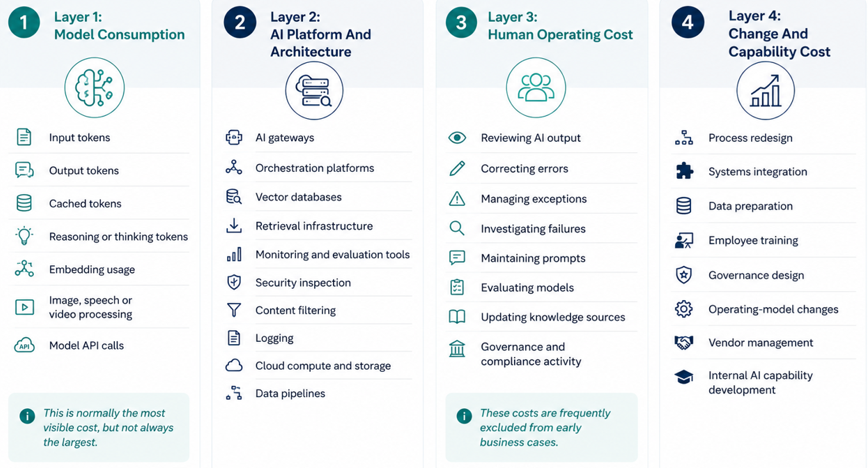
Some of the fastest-growing costs may therefore sit outside the underlying model—in orchestration, security, monitoring and the repeated processing of information through the AI architecture.
This is why token pricing alone provides an incomplete view of AI economics.
Agentic AI changes the equation
Agentic AI makes cost management more complex because the cost of an agent is not the cost of one response. It is the cost of the complete decision and execution loop.
A single transaction may require an agent to interpret a request, develop a plan, retrieve documents, call tools, evaluate results, retry failed steps, obtain verification and produce an outcome. Every stage may consume tokens, computing capacity and external services.
More importantly, this path is not always predictable. Two apparently identical transactions could retrieve different amounts of information, require different numbers of reasoning steps, make different tool calls or escalate to different models.
AI cost should therefore increasingly be understood as a range or distribution rather than a single fixed number.
This has an important implication: AI consumption can rise even while model prices fall.
Cheaper models do not automatically produce cheaper AI. Architecture, workflow design, context management and agent behaviour all influence the final unit cost.
Start with the economics of the process
One of the biggest weaknesses in many AI business cases occurs before the AI solution is even designed.
Organisations estimate how much AI might save without properly understanding what the existing process costs.
A meaningful baseline should consider transaction volumes, handling time, labour, rework, outsourcing, technology costs, losses from poor decisions, revenue leakage and operational or compliance risk.
Only then can alternative operating models be properly compared. And the answer does not always have to be AI. The appropriate operating model could be:
* Human-led;
* Rules-based automation;
* AI-assisted human; or
* AI-led with human exception management.
The objective should be to select the lowest-cost reliable operating model capable of achieving the required business outcome, rather than automatically choosing the most sophisticated AI solution.
Use the minimum sufficient intelligence
This leads to one of the most important principles of AI economics:
Use the minimum sufficient intelligence required to achieve the outcome.
Simple extraction may need only rules, OCR or a small model. Classification may suit a specialised model. Standard summarisation may use a lower-cost general model. Complex analysis may justify a more advanced model, while frontier-level reasoning should be reserved for tasks that genuinely require it.
This is where model routing becomes important. Rather than sending every task to the most capable—and often most expensive—model, organisations can route work according to complexity, risk and confidence.
At scale, these architecture decisions can have a substantial impact on AI economics.
A Proof of Value must prove the economics
The same principle should change the way organisations approach AI pilots.
A Proof of Value should not simply answer: “Does the technology work?”
It should also answer: “Do the economics work?”
That means measuring business performance, quality, operational behaviour and economics simultaneously.
Metrics such as tokens per transaction, model calls, retries, human review, rework and total cost per successful outcome should sit alongside traditional measures such as accuracy, productivity and turnaround time.
A pilot that demonstrates impressive technology but cannot demonstrate viable unit economics has not yet proven that it can scale.
Put economic guardrails in place before scale
As AI systems become increasingly autonomous, they should operate within clearly defined economic boundaries.
These could include maximum cost per transaction, token limits, maximum reasoning steps, tool calls, retries, confidence thresholds and escalation rules.
The principle is simple: No autonomous system should operate without a defined mandate, budget and stopping rule.
This moves AI cost management beyond retrospective reporting. Economics become part of the design of the AI system itself.
From AI cost to Return on Intelligence
Ultimately, the management conversation needs to move away from the price of tokens and towards unit economics and value.
* What does it cost to resolve a claim?
* What does it cost to assess a loan?
* What does it cost to onboard a customer?
* What does it cost to identify a fraudulent transaction?
And, most importantly: How much incremental business value is created for every unit of AI operating cost?
This is a more useful way of thinking about Return on Intelligence.
That value may come from increased employee capacity, higher revenue, reduced fraud and losses, faster turnaround, improved customer retention, lower outsourcing costs or reduced risk.
The first phase of enterprise AI was dominated by the question: Can AI do this?
The next phase will increasingly be defined by another: Should AI do this—and at what cost?
The organisations that succeed will not necessarily be those deploying the most sophisticated AI. They will be those that become best at converting machine intelligence into measurable business value.
AI Is Reshaping Local Banking—The Question Is Who Moves First
April 2026
Artificial intelligence is no longer a future concept for local banks—it is becoming a practical business capability that is reshaping how banks serve customers, manage risk, control costs, and remain competitive.
The real question is no longer whether AI will matter. It is whether individual institutions will move early enough—and with enough clarity and discipline—to turn that shift into advantage.
The Opportunity Is Real—but It Requires Discipline
When applied well, AI can deliver meaningful impact:
- Better customer experience
- More targeted revenue growth
- Lower cost to serve
But these outcomes do not come from experimentation or isolated pilots. They come from business-led transformation—rethinking workflows, strengthening data foundations, and embedding governance into how decisions are made.
The Market Is Changing—Fast
Customer behaviour is shifting rapidly:
- Mobile is becoming the dominant channel
- Digital expectations are rising
- Platform players are reshaping engagement
For local banks, this creates a hybrid reality:
- Cash and branches remain important in some segments
- But digital convenience increasingly defines expectations
Trying to compete head-on with large platforms on payments is not a winning strategy. The advantage for local banks lies elsewhere.
From Transactions to Trust and Intelligence
Local banks will not win by being faster transaction processors. They will win by combining:
- Trust and proximity
- Deep customer understanding
- AI-driven decision-making
Their role shifts from handling routine transactions to delivering higher-value engagement—credit, advisory, collections, SME support, and relationship-led service.
AI as the Intelligence Engine
Properly deployed, AI becomes the engine behind the bank:
- Supporting better credit decisions
- Detecting risk earlier
- Personalizing offers
- Improving turnaround times
- Reducing fraud and operational cost
This is not about replacing bankers—it’s about amplifying them.
The winning model is clear: Human decision-makers supported by machine intelligence.
Learnings From Implementations
As organisations experiment with AI, several important lessons are becoming clear. Here are a few that should inform every AI journey.

A technology-first approach often creates impressive pilots yet fails to deliver meaningful business impact. Gartner reports only 48% of AI projects make it into production, while BCG finds only 22% of companies move beyond proof of concept and just 4% create substantial value. To avoid this trap, organizations should start with business priorities and use cases, then apply AI and technology as enablers of measurable outcomes.
AI projects often fall into an old trap: automating the wrong thing instead of redesigning the process for better outcomes. Simply paving the cow paths creates speed, not value. In addition, data appeared clean and ready in the pilot but is a real mess when in production. An automation will expose flaws in leadership, process designs, data quality and operating models.


Before starting any pilots you should be clear on a number of key considerations: – does it support your business objectives, who will own the project at an executive level, how will business processes and structure be impacted, how will customer journeys be impacted, do you have clean data in place, can you actually get it into production and sustain the solution, will it be able to scaled without a resource cost multiplier effect. Without clear answers to these questions your pilot will be a pilot and money wasted.
Emerging Markets Needs Innovate Solutions
We have so much evidence and experience today to realise that traditional or “first world” solutions do not always work in emerging markets and as a result leaving many people excluded from necessary financial inclusion, education, health care and in essence a means to make a decent living.
A classic example is traditional credit scoring models that do not cater for many informal business sectors because mechanism such as credit history, payslips, proof of residence etc do not apply. Yet many of these business owners have very reliable income streams, employ people and are in fact the backbone of their local communities.
Doctor shortages across Africa leave millions of people without the basic healthcare needed.
Smallholder farmers are losing up to $200bn per annum from either crop failure or the inability to get produce to market at the right time and place.
Estimated 260m children do not have schools to attend, not even mentioning access to enough qualified teachers. A high-level calculation indicates a shortage of 6.5m teachers just in developing regions.
This world therefore needs a new way of solving issues in emerging markets. The advancement of technology and AI can and is already providing much needed relief to many of these issues.
Cities in emerging markets are losing billions a year to traffic congestions. Just take a drive through cities like Lagos, Nairobi, Kampala, Dae es Salaam and Cairo to experience the impact, not only financially but also on mental well-being.
Solutions to these pain points need news way of thinking and innovation patterns such as hybrid human-AI models, low-bandwidth design, alternative data solutions and voice-first interfaces are way forward.
By using these patterns, we now see solutions such Zuri Health that uses AI-enabled symptom checkers to reduce diagnosis time, Qure.ai uses portable X-rays analysed by AI to detect TB, Plantix diagnoses crop diseases via phone photos with 90% accuracy, Okra’s “plaid for Africa” solution uses ML models to analyse cash flow patterns for loan eligibility, Imagine launched an adaptive learning platform for students in a number of African countries, allowing kids with tablets access to all the content they require.
In conclusion, with short blog, my message is that all enterprises operating in the emerging market must seek for these new solutions to enable their customers in affordable ways to become “included” in the world we live in today.